


The History of Tsurugaoka Castle
更新日:2026年3月19日
The History of Tsurugaoka Castle
The construction of Tsurugaoka Castle is said to have begun in the early Muromachi Period (1336-1573) under Nagamori Muto, and was originally named “Daihoji Castle”. Following the downfall of the Muto clan (also known as Daihoji clan), the castle came under the control of the Uesugi clan, which originated from Echigo province (Niigata Prefecture).
In 1601, the Mogami clan from Yamagata made Shonai their base of operations, and two years later, the castle was renamed “Tsurugaoka Castle”. After the fall of the Mogami clan in 1622, Tadakatsu Sakai, originally from Matsushiro (Nagano Prefecture), became the lord of the Shonai Domain. The Sakai clan ruled the area for 12 generations, approximately 250 years, and resided in Tsurugaoka Castle until the establishment of the prefecture system in 1871.
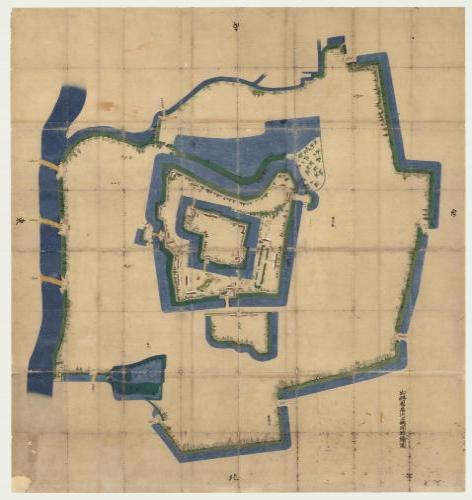
Plan of Tsurugaoka Castle, in Shonai, Dewa Province (Held by the Tsuruoka City Local History Archives)
Plan of Tsurugaoka Castle, in Shonai, Dewa Province
(PDF:929KB)
Structure and Characteristics of Tsurugaoka Castle
Tadakatsu Sakai initiated extensive improvements to the castle, including the construction of Sannomaru (the third enclosure). These constructions took over three generations, spanning about 50 years, during which urban planning for the castle town was also developed. This layout remains in Tsuruoka’s city center to this day.
Tsurugaoka Castle was a flatland castle designed in a concentric ring structure: the Honmaru (main enclosure) at the center, surrounded by Ninomaru (second enclosure), and then the Sannomaru (third enclosure). Each enclosure was surrounded with earthen embankments and moats.
At the heart of the castle was the Honmaru Goten (palace), a single-story building of 923 tsubo (approx. 3,051m2). The palace included various rooms such as a living room, a kuroshoin (private meeting hall), a shiroshoin (public audience hall) and a Noh stage. In Ninomaru, there was a horse-riding ground, weapons storehouses with thick earthen walls, and other facilities. Sannomaru housed about 180 samurai residences, the domain school Chidokan, seven granaries, stables, and more.
In the northwest corner of Honmaru stood a two-story turret (sumi-yagura) called Inui Yagura. A similar turret, Tatsumi Yagura, was located in the southeast corner of Ninomaru. The castle had several gates: the Otemon Gate (main gate) featured a kaku-umadashi, a square-shaped defensive compound to prevent direct access to the castle; the Nakanomon Gate (central gate) had a masugata, a square space enclosed by two gates for protection and troop concentration during attacks; and at the Nishimon Gate (west gate), a soto-masugata (also referred to as a maru-umadashi) formed a defensive area built outside the castle entrance. The Sotokitamon Gate (outer north gate) had an umadashi for defense.
The majority of the castle’s outer defense consisted of earthen embankments topped with a continuous ridge-tile roof, featuring alternating shooting holes for firearms and arrows. Only the lower parts of the turrets and gates were fortified with stacked stone walls (ishigaki). The eastern area of the castle was protected by the Uchikawa River, which served as a moat flowing north-south through the city, while on the southern area a wide moat (hyakkenbori) was built using the river’s former course. In the northern area, a reservoir further strengthened the castle’s defenses.
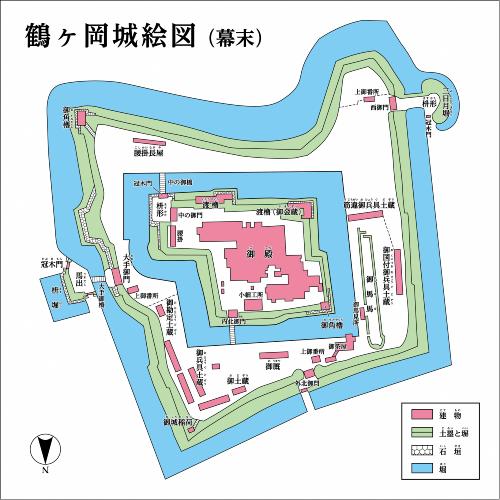
Plan of Tsurugaoka Castle
Source: Ose Kinya, “Tsuruoka Castle town”, published by Shonai Rekishi Chosakai [Shonai Historical Research Committee], edited version
Plan of Tsurugaoka Castle
(PDF:418KB)
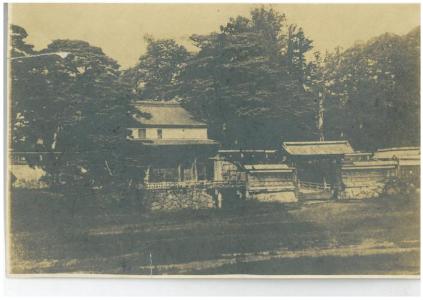
Tsurugaoka Castle, Otemon Gate (Early Meiji period, photograph, held by the Tsuruoka City Local History Archives)
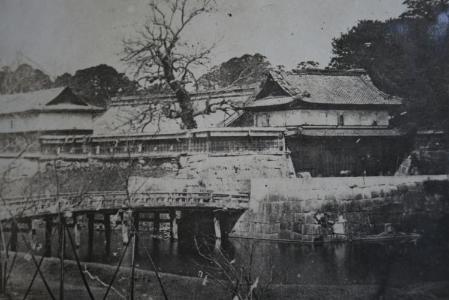
Tsurugaoka Castle, Nakanomon Gate (Early Meiji period, photograph, held by the Tsuruoka City Local History Archives)
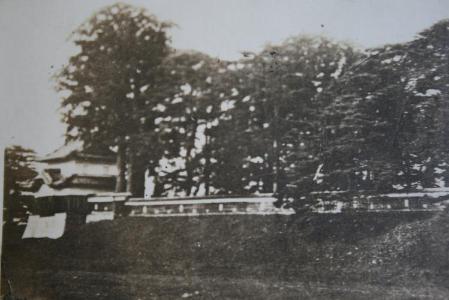
Tsurugaoka Castle, Corner Turret in Ninomaru (Early Meiji Period, photograph, held by the Tsuruoka City Local History Archives)
Demolition of Tsurugaoka Castle and Development of Tsuruoka Park
In September 1868, the Shonai Clan capitulated during the Boshin War (1868-1869) and surrendered Tsurugaoka Castle to the new government forces. In 1876, all the buildings within the castle grounds were demolished, most earthworks were destroyed, and the moats were filled in, in accordance with the Castle Abolition Order (1873), giving way to the creation of Tsuruoka Park.
The following year, the residents, cherishing the memory of the Sakai clan’s good administration, decided to build the Shonai Shrine at the site of the Honmaru within the park, to honor their late feudal lords. To this day, the head of the Sakai family is still referred to as “lord”, deeply respected by the people and resides in Tsuruoka.
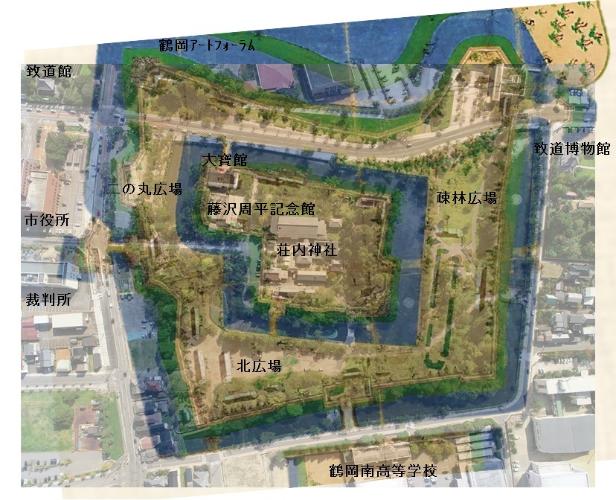
Overlay map
Overlay map of the castle plan and an aerial photograph of Tsuruoka Park
(PDF:540KB)
Tsuruoka Park Ninomaru Plaza Historical Site Board
Historical Site Board: Tsurugaoka Castle Ninomaru Site
Tsurugaoka Castle Ninomaru Site
(PDF:447KB)
Historical Site Board: Kinbo Stones
Kinbo Stones Discovered near Tsuruoka Park Ninomaru Plaza
During a road improvement project conducted by Yamagata Prefecture involving the installation of gas pipes, Kinbo stones were discovered at the Ninomaru Plaza of the park. Since the excavation site corresponds to the former location of Tsurugaoka Castle’s Ninomaru outer moat, it is presumed that Kinbo stones were used to build the stone walls of this enclosure.
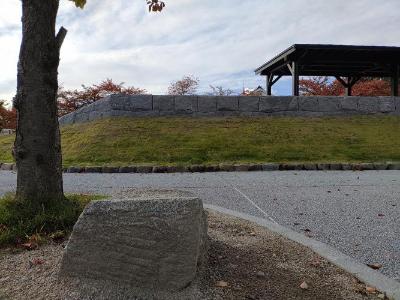
Excavated Kinbo Stone
Context of the Kinbo Stone Discovery
(PDF:386KB)
Context of the Kinbo Stone Discovery (Photo taken on Sept. 2, 2022)
PDF形式のファイルを開くには、Adobe Reader(旧Adobe Acrobat Reader)が必要です。
お持ちでない方は、Adobe社から無償でダウンロードできます。
 Adobe Readerのダウンロードページへ
お問合わせ
メールでの回答が必要な場合は、住所・氏名・電話番号を明記してください。
鶴岡市役所 都市計画課
〒997-8601 山形県鶴岡市馬場町9番25号
電話:0235-35-1315
FAX:0235-25-2059